

Best Vacuum for Pet Hair: 2026 Buying Guide
Table of Contents
- How We Chose the Best Vacuums for Pet Hair
- Quick Comparison: Top Picks for Pet Hair
- Best Vacuum for Pet Hair on Carpet
- Best Cordless Vacuum for Pet Hair
- Best Canister Vacuum for Pet Hair
- Pet Hair Vacuum with HEPA Filter: Allergy Relief
- Long-Term Ownership: Costs, Repairs, and Maintenance
- Conclusion
- Frequently Asked Questions
Last Updated: October 15, 2026
How We Chose the Best Vacuums for Pet Hair
Finding the best vacuum for pet hair starts with understanding what pet hair does to a machine: it wraps around brush rolls, clogs filters, and defeats weak suction faster than almost any other debris.
Pet hair is one of the toughest tests a vacuum faces: it clings to carpet fibers, tangles around rotating brushes, and triggers allergies when it recirculates through a leaky filtration system.
We judged every category on five things:
- Pickup performance on carpet, hard floors, and upholstery
- Brush roll design , especially tangle-free and motorized options
- Filtration , including HEPA and sealed systems that trap pet dander
- Weight and maneuverability for stairs and furniture
- Repairability and parts availability , because a vacuum you can fix lasts far longer
What most buying guides skip is the last point. The U.S. Environmental Protection Agency's indoor air quality guidance notes that pet dander is a common indoor allergen, which makes filtration a health decision, not just a cleaning preference.
Quick Comparison: Top Picks for Pet Hair
Here is how the main vacuum types stack up for pet owners before we dig into each one.
| Vacuum Type |
Best For |
Strengths |
Trade-Offs |
|---|---|---|---|
| Upright |
Deep carpet cleaning |
Strong suction, wide path |
Heavier, harder on stairs |
| Cordless stick |
Quick daily cleanups |
Light, fast, maneuverable |
Shorter runtime, smaller bin |
| Canister |
Stairs and multi-surface homes |
Reach, large capacity |
Bulkier to store |
| Handheld |
Furniture and cars |
Portable, precise |
Small bin, short runtime |
The right choice depends less on brand hype and more on your flooring mix, your pet's shedding level, and how much you're willing to maintain the machine.
Best Vacuum for Pet Hair on Carpet
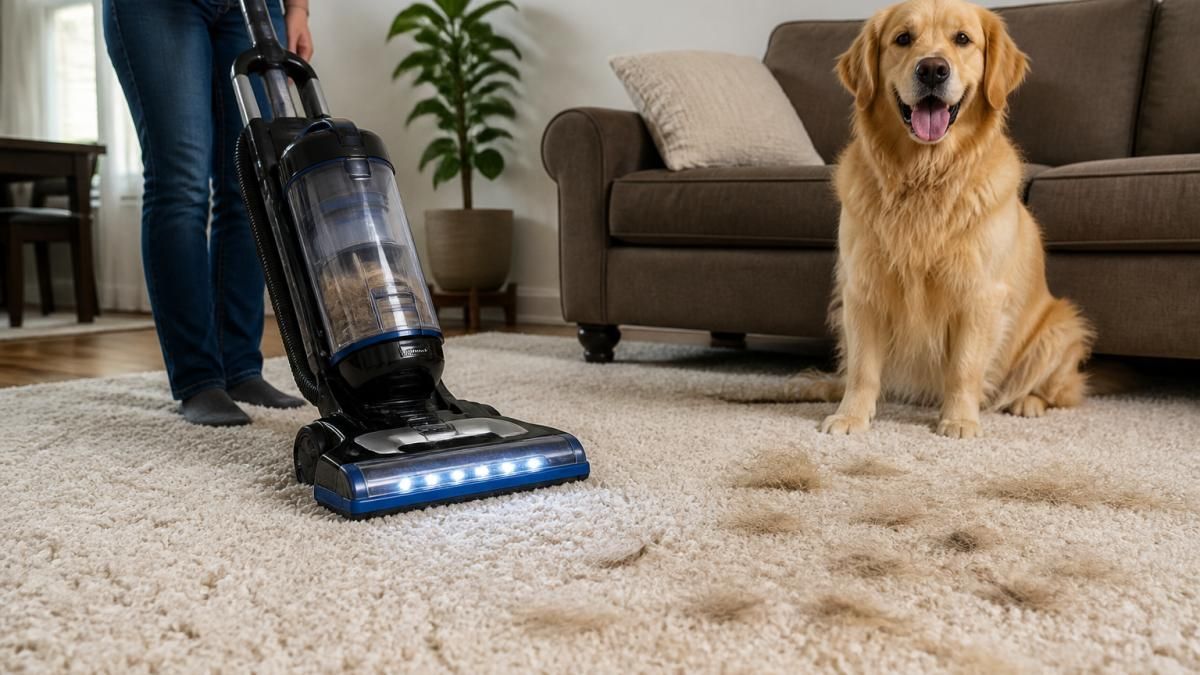
The best vacuum for pet hair on carpet is a corded upright with a motorized brush roll, adjustable height, and a sealed airway. Carpet traps hair deep in the pile, and only a powered brush plus sustained airflow pulls it free; battery models often lose suction as the charge drops.
Why Carpet Is the Hardest Test for Pet Hair
Pet hair behaves differently on carpet than on hard floors. On hard surfaces, hair sits on top and airflow alone lifts it.
That is why two vacuums with identical suction ratings can perform very differently on the same rug. Suction measures pressure, not how much air moves through the cleaning head; airflow, the volume of air moved per minute, is what lifts hair out of the pile.
Brush Roll Design: The Single Biggest Variable
Not all brush rolls are built for pet hair. The three designs you will encounter behave very differently:
- Standard bristle brush roll. Stiff bristles agitate the carpet and flick hair loose. Effective on low and medium pile, but hair wraps around the bristles and shaft, and you will be cutting it free regularly.
- Dual brush roll (soft front roller plus stiff rear roller). The soft roller pulls fine debris and surface hair, while the stiff roller agitates deeper pile. Common on premium uprights and generally the best all-around carpet design for shedding pets.
- Tangle-resistant or rubber-finned brush roll. Angled rubber fins or a tapered, counter-rotating design sheds hair into the airway rather than wrapping it. These reduce maintenance on long-haired pets, but can be less aggressive on very deep, dense pile.
A removable end cap saves the most frustration over a vacuum's life: sliding the brush roll out lets you clear wrapped hair in a minute instead of picking at it with scissors.
Adjustable Height and Sealing
Height adjustment lets the brush reach the base of the carpet rather than skating across the top. On thick pile, a head that sits too high leaves the lower third untouched; too low, and the brush stalls.
Sealing matters just as much: a sealed system keeps the air path gasketed from cleaning head to filter, so dander and fine dust cannot escape back into the room. On carpet, an unsealed machine can put more dust into the air than it removes.
How to Test Carpet Pickup Yourself
You do not need a lab to compare two vacuums on your own carpet. A repeatable home test:
- Sprinkle a measured amount of dry rice or baking soda across a 3-by-3-foot section of carpet to simulate grit and fine debris.
- Scatter a visible pinch of shed pet hair (brush your pet first) over the same area.
- Make a set number of slow passes, five forward, five back, in one direction.
- Empty the bin onto a white paper towel and compare what came up.
- Repeat on a different pile height or a different rug to see how the vacuum adapts.
Run the same test on low-pile, medium-pile, and a thick area rug. A vacuum that wins on one pile height often loses on another.
Common Mistakes on Carpet
A lightweight stick vacuum is a poor primary tool for a fully carpeted home: it works for surface hair but leaves the deep pile untouched. The same goes for a canister with a non-motorized floor tool, airflow alone will not pull matted hair out of medium or thick pile.
Best Cordless Vacuum for Pet Hair
A cordless stick vacuum is the best choice for daily touch-ups, stairs, and quick cleanups between deep cleans. It won't replace a corded upright on wall-to-wall carpet, but for hard floors and low-pile rugs, it's the tool you'll actually reach for.
Battery Chemistry and Runtime Fade
Runtime is where cordless models earn or lose their place. Most run for a limited window on high power, and that window shrinks as the battery ages. Two things drive that:
- Battery chemistry. Lithium-ion packs hold voltage fairly flat until they near empty, then drop off. Older nickel-cadmium packs faded gradually, so a machine that felt strong when new lost power steadily. Nearly all current cordless vacuums use lithium-ion, but cell and circuitry quality still varies widely.
- Power mode. A vacuum's advertised maximum runtime almost always reflects the lowest power setting. On high power, where pet hair actually gets picked up, runtime commonly drops to a fraction of that figure. Judge a cordless vacuum by its high-power runtime, not its eco-mode claim.
If you have a large home, plan on a spare battery or accept that a cordless vacuum is a supplement, not a replacement.
Bin Volume and Emptying Frequency
Weight matters too. A lighter stick vacuum is easier on stairs and overhead work, but lighter often means a smaller dustbin you'll empty more often. For heavy shedders, that's a daily chore.
For allergy sufferers, emptying is also a dust event. Look for a bin that seals when closed and empties from the bottom, so you are not reaching into a cloud of dander.
Cordless Brush Rolls and Hair Wrap
Cordless stick vacuums concentrate hair wrap in a small cleaning head, so the problem shows up faster than on a full-size upright. Soft-roller designs handle fine debris and surface hair well but can mat with long hair.
Because the head is small and the airway is short, a cordless vacuum also clogs more easily at the inlet. Check the inlet and brush roll every few uses, not once a month.
Where Cordless Wins and Where It Doesn't
Cordless vacuums win on hard floors, low-pile rugs, stairs, car interiors, and quick daily passes. They lose on thick carpet, large homes, and any job needing sustained high-power suction for more than a few minutes.
A practical setup for a shedding household is a corded upright or canister for the weekly deep clean and a cordless stick for the daily touch-up. That combination covers more ground than either machine alone.
Best Canister Vacuum for Pet Hair
A canister vacuum is the best vacuum for pet hair in homes with stairs, mixed flooring, and furniture to navigate.
For pet owners, the key advantage is the tool set. A motorized pet tool and an upholstery tool handle furniture, while a crevice tool gets into corners where hair collects.
The trade-off is storage and setup. A canister takes more floor space and requires dragging the body along as you clean.
Pet Hair Vacuum with HEPA Filter: Allergy Relief
A pet hair vacuum with a HEPA filter is the right pick if anyone in the home deals with allergies or asthma. HEPA filtration traps fine particles, including pet dander, instead of blowing them back into the air.
The catch is that filtration only works if the system is sealed.
Filter maintenance decides long-term performance. Clogged filters cut suction and force the motor to work harder. Rinse or replace filters on schedule, and the vacuum keeps performing for years.
Long-Term Ownership: Costs, Repairs, and Maintenance
The cheapest vacuum is rarely the least expensive to own. Big-box models often can't be repaired because parts aren't available, so a minor failure means a full replacement.
Maintenance is the difference between a vacuum that lasts a decade and one that dies in two.
This is where a local, family-owned shop earns its keep.
If you're weighing repair against replacement, ask three questions: Is the part still available, is the motor still strong, and does the repair cost less than a comparable new machine?
Conclusion
Pet hair punishes weak vacuums, and the wrong machine turns a quick chore into a daily battle. Match the vacuum to your flooring, your pet's shedding, and your willingness to maintain it, and you'll get years of reliable service instead of a disposable disappointment.
That's the difference a specialist makes. Olson Vacuum Cleaner Sales & Service Inc. offers high-quality brands that outlast big-box alternatives, expert repairs backed by a warranty, and rug shampooer rentals for seasonal deep cleaning.
Frequently Asked Questions
What vacuum has the best suction for pet hair?
Suction alone isn't the only factor. For pet hair, look for a vacuum with strong airflow, a motorized brush roll, and sealed HEPA filtration. Upright and canister models with adjustable height settings typically perform best on carpet because they agitate embedded hair. Cordless stick vacuums have improved, but their smaller motors and limited runtime make them better for quick cleanups than deep cleaning. The best choice depends on your flooring mix and how much hair your pet sheds.
Are bagged or bagless vacuums better for pet hair?
Bagged vacuums tend to be better for pet hair and allergies. The sealed bag traps dander and fine dust so it doesn't re-enter the air when you empty the bin. Bagless models are convenient and save on bag costs, but emptying the dustbin can release allergens. If you have allergy sufferers at home, a bagged vacuum with HEPA filtration is often the safer choice. Bagless works well if you empty the bin outdoors and clean filters regularly.
How do I keep pet hair from tangling around a vacuum brush roll?
Look for a vacuum with a tangle-free brush roll or a removable brush design that's easy to clean. After each use on carpet, check the brush roll for wrapped hair and cut it away with scissors. Some models include a hair-wrap prevention feature that channels hair into the dustbin instead of the brush. Regular maintenance, at least once a month, prevents reduced suction and motor strain. If hair wraps frequently, your brush roll may need replacement.
Which vacuum works best for pet hair on carpet and hardwood?
A canister vacuum with a motorized carpet head and a separate hard-floor brush is the most versatile option. You can switch attachments without changing machines. Upright vacuums with adjustable height and brush roll shutoff also work well on both surfaces. For homes with mostly hardwood and a few area rugs, a cordless stick vacuum with a soft roller may be sufficient. The key is having a brush roll you can turn off for delicate hard floors.



Share On: